


Thursday, 2 April 2015

Tuesday, 17 March 2015
St Joseph of Arimathea

St Joseph of Arimathea was a disciple of Jesus, probably ever since Christ's first preaching in Judea (John 2: 23), but he did not declare himself as such "for fear of the Jews" (John 19: 38). On account of this secret allegiance to Jesus, he did not consent to His condemnation by the Sanhedrin (Luke 23: 51), and was most likely absent from the meeting which sentenced Jesus to death (Mark 14: 64). The Crucifixion of the Master quickened Joseph's faith and love, and suggested to him that he should provide for Christ's burial before the Sabbath began. Unmindful therefore of all personal danger, a danger which was indeed considerable under the circumstances, he boldly requested from Pilate the Body of Jesus, and was successful in his request (Mark 15: 43-45). Once in possession of this sacred treasure, he — together with Nicodemus, whom his courage had likewise emboldened, and who brought abundant spices — wrapped up Christ's Body in fine linen and grave bands, laid it in his own tomb, new and yet unused, and hewn out of a rock in a neighbouring garden, and withdrew after rolling a great stone to the opening of the sepulchre (Matthew 27: 59, 60; Mark 15: 46; Luke 23: 53; John 19: 38-42). Thus was fulfilled Isaiah's prediction that the grave of the Messiah would be with a rich man (Isaiah 53: 9). The Greek Church celebrates the feast of St Joseph of Arimathea on July 31st, and the Catholic Church on March 17th. Additional details are found concerning Joseph in the apocryphal Acta Pilati. There is also apocryphal legend telling of Joseph accompanying the Apostle Philip, Lazarus, Mary Magdalene and others on a preaching mission to Gaul. Lazarus and Mary stayed in Marseilles, while the others travelled north. At the English Channel, Philip sent Joseph, with twelve disciples, to establish Christianity in the most far-flung corner of the Roman Empire, the British Isles. The year AD 63 is commonly given for this event, with AD 37 sometimes being put forth as an alternative. Comprehensive coverage of this is found in my book The Grail Church.

Friday, 13 December 2013
Wednesday, 2 October 2013
Holy Guardian Angels

"For he hath given his angels charge over thee; to keep thee in all thy ways.” - Psalm 90: 11
"No evil shall befall you, nor shall affliction come near your tent, for to His Angels God has given command about you, that they guard you in all your ways. Upon their hands they will bear you up, lest you dash your foot against a stone" - Psalm 91: 10-12
The Catechism of the Catholic Church states: “From infancy to death human life is surrounded by their watchful care and intercession”(No. 336). St Basil asserted: “Beside each believer stands an angel protector and shepherd leading him to life. ”
The truth that each and every human soul has a Guardian Angel who protects us from spiritual and physical evil has also been shown throughout the Old Testament, and is made very clear in the New Testament.
It is written that the Lord Jesus is strengthened by an angel in the Garden of Gethsemane and that an angel delivered St Peter from prison in the Acts of the Apostles.
But Jesus makes the existence and function of guardian angels explicit when He says: "See that you despise not one of these little ones: for I say to you, that their angels in heaven always see the face of my Father who is in heaven." (Matthew 18: 10).
In saying this, Jesus points out that all people, even little children, have a guardian angel and that the angels are in Heaven, always looking at the face of God throughout their mission on earth, which is to guide us and protect us throughout our pilgrimage to the house of our Father. As St Paul says: "Are they not all ministering spirits, sent to minister for them, who shall receive the inheritance of salvation?"(Hebrews 1: 14)
However, they guide us to Heaven only if we desire it. St Thomas Aquinas wrote that angels cannot act directly upon our will or intellect, although they can do so on our senses and imaginations – thus encouraging us to make the right decisions. In Heaven our guardian angels, though no longer needing to guide us to salvation, will continue to enlighten us.
It is important to pray to your guardian angel and become friends with your angel. Ask for your guardian angel's help when you're stuck in traffic, when you need a parking place, and when you need help with your computer or the Internet. Call upon them in times of temptation or weakness and they will assist, enlighten, and protect you.
The prayer to the guardian angels has been present in the Church since at least the beginning of the 12th century.
Guardian Angel Prayer:
Angel of God, my Guardian dear, to whom God's love commits me here, ever this day be at my side, to light and guard, to rule and guide. Amen.
Guardian Angel Quotes:
"The servants of Christ are protected by invisible, rather than visible, beings. But if these guard you, they do so because they have been summoned by your prayer. "
~ St Ambrose
“Let us affectionately love His angels as counselors and defenders appointed by the Father and placed over us. They are faithful; they are prudent; they are powerful; Let us only follow them, let us remain close to them, and in the protection of the God of heaven let us abide.”
~ St Bernard of Clairvaux
"God's universal providence works through secondary causes . . . The world of pure spirits stretches between the Divine Nature and the world of human beings; because Divine Wisdom has ordained that the higher should look after the lower, Angels execute the Divine plan for human salvation: they are our Guardians, who free us when hindered and help to bring us home."
~ St Thomas Aquinas

Tuesday, 1 October 2013
St Thérèse of the Child Jesus
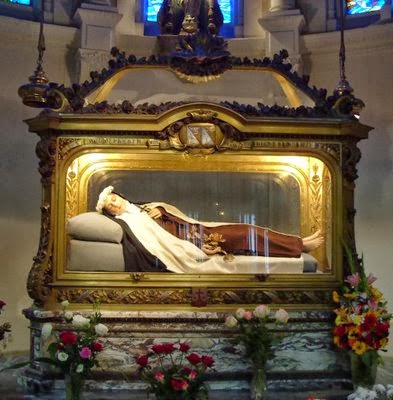
St Thérèse of the Child Jesus and the Holy Face was buried in the Lisieux municipal cemetery on 4 October 1897. She was the first to be buried in the new plot her monastery had purchased in response to the city's new legislative directives prohibiting interment inside the cloister. In view of what took place after St Thérèse's death, it can now be said that the new directives were providential, since they enabled hundreds of thousands of pilgrims to visit her grave over a period of twenty-five years. Had St Thérèse been buried inside the cloister, this would never have been possible. Only in 1923 on the occasion of her beatification were her mortal remains transferred to the Carmelite chapel where they are kept to this day.

When people stand in the presence of the mortal remains of St Thérèse of Lisieux, or have some contact with her relics, as with petals from an unpetalled rose, God, who received through her humanity so many signs of love, is pleased in turn to manifest his love through her bodily remains.

From these poor signs, God's salvific power reveals and unfolds itself. It is enough to read the many volumes recounting favours and cures obtained through contact with St Thérèse's relics, as well as the abundant correspondence that arrives daily in Lisieux.

We are indeed blessed at the Holy Grail retreat to be able to display numerous first class relics of St Thérèse at a dedicated shrine created for the purpose of veneration. Alongside her holy relics are those of beloved St Francis and St Clare of Assisi.
.
Thursday, 13 December 2012
St Lucy (Lucia)
.

Saint Lucy's (Lucia) name means "light", with the same root as "lucid" which means "clear, radiant, understandable." Unfortunately for us, Lucy's history does not match her name. Shrouded in the darkness of time, all we really know for certain is that this brave woman who lived in Syracuse lost her life in the persecution of Christians in the early fourth century. Her veneration spread to Rome so that by the sixth century the whole Church recognised her courage in defence of the faith.
Because people wanted to shed light on Lucy's bravery, legends grew up. The one that is passed down to us tells the story of a young Christian woman who had vowed her life to the service of Christ. Her mother tried to arrange a marriage for her with a pagan. Lucy apparently knew that her mother would not be convinced by a young girl's vow so she devised a plan to convince her mother that Christ was a much more powerful partner for life. Through prayers at the tomb of Saint Agatha, her mother's long illness was cured miraculously. The grateful mother was now ready to listen to Lucy's desire to give her money to the poor and commit her life to God.
Unfortunately, legend has it, the rejected bridegroom did not see the same light and he betrayed Lucy to the governor as a Christian. This governor tried to send her into prostitution but the guards who came to take her way found her stiff and heavy as a mountain. Finally she was killed. As much as the facts of Lucy's specific case are unknown, we know that many Christians suffered incredible torture and a painful death for their faith during Diocletian's reign. Lucy may not have been burned or had a sword thrust through her throat but many Christians did and we can be sure her faith withstood tests we can barely imagine.
Lucy's name is probably also connected to statues of Lucy holding a dish with two eyes on it. This refers to another legend in which Lucy's eyes were put out by Diocletian as part of his torture. The legend concludes with God restoring Lucy's eyes.

Lucy's name also played a large part in naming Lucy as a patron saint of the blind and those with eye-trouble.
Whatever the fact to the legends surrounding Lucy, the truth is that her courage to stand up and be counted a Christian in spite of torture and death is the light that should lead us on our own journeys through life.

Prayer:


Her name meaning light is a factor in the particular devotion to Saint Lucy receives in Scandinavian countries, where young girls dress as the saint in honour of the feast.

.
Monday, 15 October 2012
St Teresa of Avila
.

St Teresa of Avila’s scent emanated throughout the whole monastery the moment she died. Saint Thérèse de Lisieux (known as “the Little Flower”) was said to have produced a strong scent of roses at her death, which was detectable for days afterward. Likewise, Padre Pio’s stigmata is said to have emanated the smell of roses.


Born to the Spanish nobility, the daughter of Don Alonso Sanchez de Cepeda and Doña Beatriz, Teresa grew up reading the lives of the saints, and playing at “hermit” in the garden. Crippled by disease in her youth, which led to her being well educated at home, she was cured after prayer to St Joseph. Her mother died when Teresa was 12, and she prayed to Our Lady to be her replacement. Her father opposed her entry to religious life, so she left home without telling anyone, and entered a Carmelite house at 17. Seeing her conviction to her call, her father and family consented.
Soon after taking her vows, Teresa became gravely ill, and her condition was aggravated by the inadequate medical help she received; she never fully recovered her health. She began receiving visions, and was examined by Dominicans and Jesuits, including Saint Francis Borgia, who pronounced the visions to be holy and true.
She considered her original house too lax in its rule, so she founded a reformed convent of Saint John of Avila. Teresa founded several houses, often against fierce opposition from local authorities. Mystical writer. Proclaimed a Doctor of the Church on 27 September 1970 by Pope Paul VI.
There are more than one type of stigmata. Some affected people display no outward signs of the stigmata at all. These are referred to as the invisible stigmata. Other stigmatics' wounds refuse to clot or heal. They remain fresh and uninfected.
In very rare cases the blood is said to have a perfumed odour, known as the Odour of Sanctity. The Odour of Sanctity can also be present separate from stigmata. Saint Teresa of Avila was reported to have emitted heavenly scents after she died.
Those who have shown the wounds of Christ are often ecstatics. Upon receiving the stigmata they receive a mystical vision of Christ. While the have been extremely rare cases on non-Catholic stigmatics most are devout Catholics.
The first mentioned stigmatic is St Francis of Assisi in whom the stigmata were of a character never seen subsequently. Since that time over five hundered stigmatics have been accepted by the Roman Catholic Church. The first record of a female stigmatic is the Blessed Christina von Stommeln circa 1310.
St Teresa of Avila’s scent emanated throughout the whole monastery the moment she died. Saint Thérèse de Lisieux (known as “the Little Flower”) was said to have produced a strong scent of roses at her death, which was detectable for days afterward. Likewise, Padre Pio’s stigmata is said to have emanated the smell of roses.

http://pathofreconciliation.blogspot.co.uk/2010/10/st-teresa-of-avila.html
http://www.marypages.com/TeresaofAvila.htm
http://www.marypages.com/TeresaofAvila.htm
.
Subscribe to:
Posts (Atom)